Keep the locator consistent with how the rest of the site handles countries, rather than inventing a separate scheme for locations. Address format, phone format, distance units, date and time format and opening hours conventions all change by country, and every one of them is visible to a customer. Translate the page furniture and keep the address in the local format, because an address is not a sentence to be translated.
Locators across countries and languages break in small ways. A locator that works in one country usually breaks in the second one in small, embarrassing ways: a postcode in the wrong place, miles in a metric country, a phone number nobody can dial.
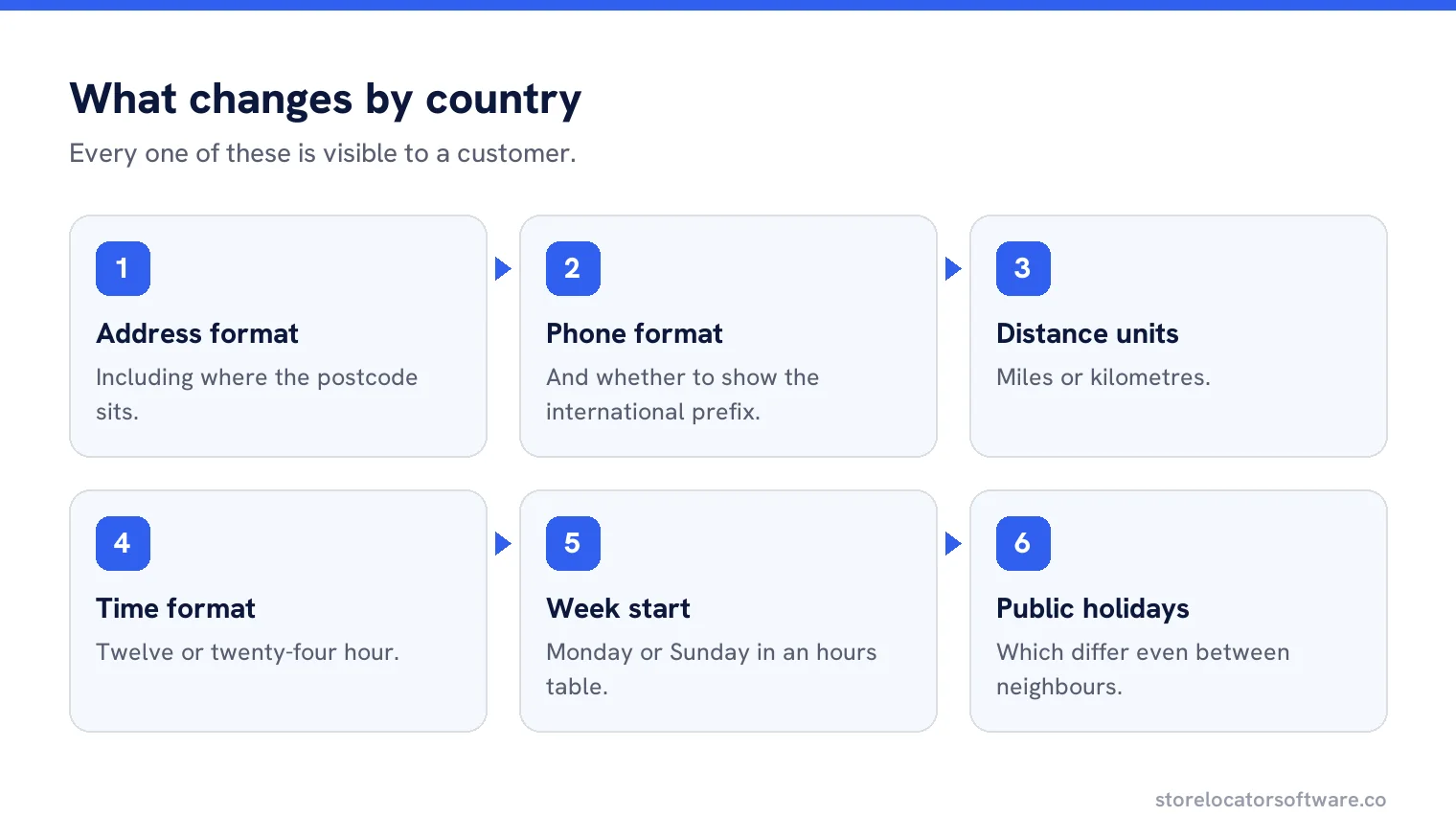
What changes by country
- Address order and format, including where the postcode sits.
- Phone format, and whether to show the international prefix.
- Distance units, miles or kilometres.
- Time format, twelve or twenty-four hour.
- Week start, Monday or Sunday, in an opening hours table.
- Public holidays, which differ even between neighbours.
Addresses are not translated
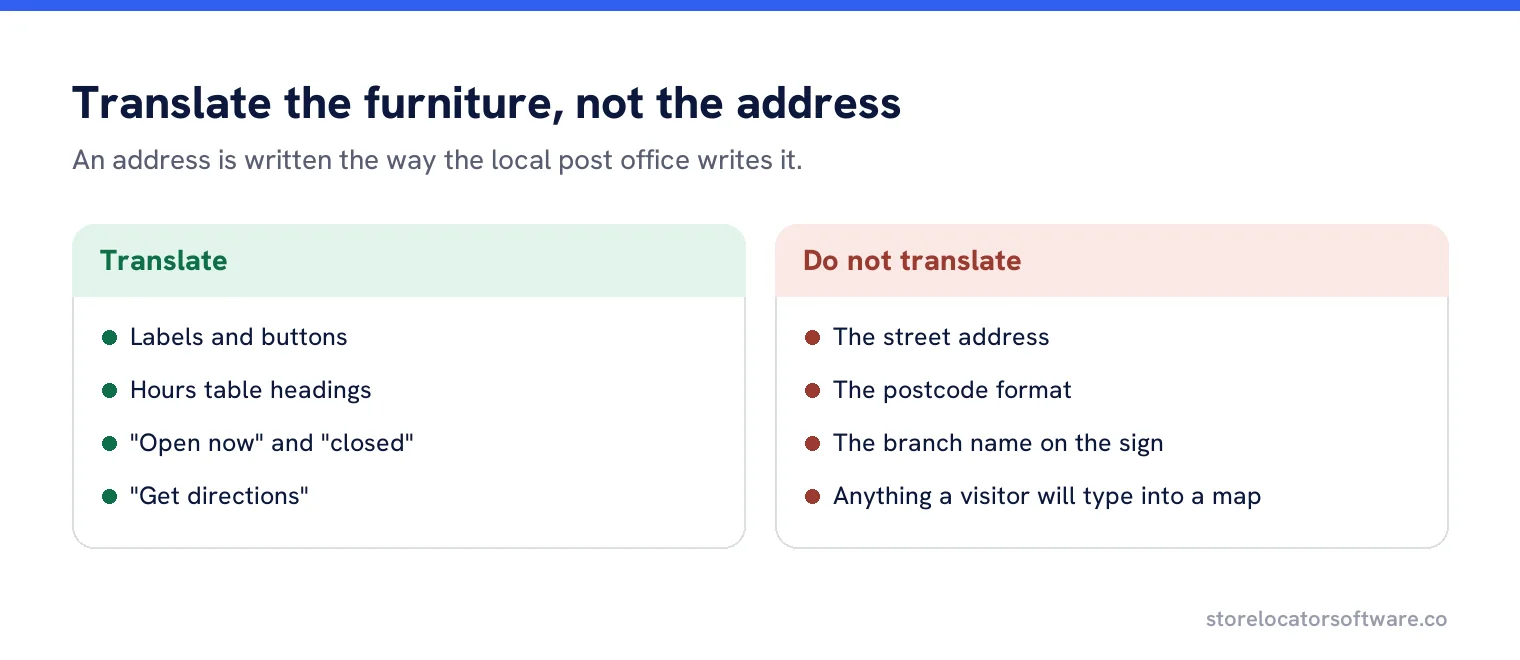
An address is written the way the local postal service writes it, in the local language, regardless of the language the page is in. A German branch’s address appears in German on the English page, because that is what the visitor will type into a map and read on a street sign.
What you translate is the furniture: the labels, the buttons, the hours table headings, the “get directions” text.
Structure that matches the site
| Site structure | Locations |
|---|---|
| Country folders, such as /uk/ and /de/ | Locations under each country folder. |
| Separate domains per country | Each domain lists its own locations. |
| One site, several languages | One set of location pages per language, with the same addresses. |
| One site, one language, several countries | One locations section, grouped by country. |
Whatever the site does, the locations follow it. A locations section organised differently from everything else is a maintenance problem and a navigation surprise.
Language versions of the same branch
Where a branch page exists in several languages, each version needs its own URL, the same address in the local format, and the appropriate language annotations linking the versions to each other. The common failure is one page in two languages switched by a cookie, which gives search engines one URL and visitors the wrong language.
Currency and prices
Where a location page mentions prices, they belong in the local currency with no conversion. A converted price is wrong by the time somebody reads it and creates an expectation the branch cannot honour. If the business genuinely charges differently by country, say so plainly on each page rather than publishing one number with an asterisk.
Hours across time zones
“Open now” is calculated in the branch’s time zone, not the visitor’s. A customer in London looking at a Madrid branch should see whether it is open in Madrid. This sounds obvious and is wrong in a surprising number of locators, which calculate from the browser’s clock.
Search that works locally
Each country has its own way of describing where somewhere is: postcodes, postal codes, prefectures, départements, provinces. A search box that only understands one country’s format will fail politely for everybody else. Accept what people actually type in that country, and test with three local examples before launch.
Phone numbers that can be dialled
Display the number the way a local would dial it, and make the link work for everybody. That usually means showing the national format on the page while the underlying link carries the international format, so a visitor from another country taps once and gets through rather than copying digits and guessing a prefix.
It matters most for businesses whose customers travel: hotels, car hire, clinics near borders, anything at an airport. For those, a number that only works domestically is a lost booking rather than an inconvenience.
Names of places
Cities often have different names in different languages, and visitors search in both. The page can carry the local name as the primary and mention the alternative naturally in the text, which serves both without producing an odd hybrid in the heading. What not to do is translate the name in the address block, which breaks the thing the address exists for.
A worked example
A retailer expanded from the UK into Ireland and the Netherlands using the same locator. Three faults appeared in the first week: distances in miles for Dutch visitors, Irish Eircodes rejected by the postcode validator, and opening hours showing a Monday start in a table laid out for the UK bank holiday calendar.
All three were configuration rather than development, and all three were reported by customers rather than caught in testing, because testing had been done from a desk in Manchester.
Translating the locator page itself
Translate it properly, by somebody who speaks the language, including the phrases that look trivial: “open now”, “closed”, “get directions”, “nearest branch”. Machine translated interface text on an otherwise careful page is noticeable, and it is noticed most by the customers you are trying to reach.
Profiles follow the same rules
Everything here applies to the Business Profiles behind the locations as well. Each profile carries its own address in the local format, its own hours in local time, and its own category in that country’s taxonomy. A bulk upload that applies a single address format across several countries is the usual way an estate gets published incorrectly all at once.
Who checks it
Somebody in the country, every time. Head office cannot see that a Dutch address is formatted oddly or that a French opening hours table starts on the wrong day, and neither can an agency three countries away. One local colleague reading one page catches more than any amount of specification.
Testing before launch
From each country, with a local postcode, in the local language, on a phone. Four tests per country, half an hour, and it catches nearly everything above. The alternative is being told by customers, which is how most of these faults are actually discovered.
Every country, formatted properly
Manage locations across countries from one place, with local formats, units and hours handled for each.
Frequently asked questions
Should addresses be translated?
No. An address is written the way the local postal service writes it, in the local language, because that is what the visitor types into a map and reads on a sign.
What should be translated?
The page furniture: labels, buttons, hours table headings and phrases like "open now" and "get directions", translated by somebody who speaks the language.
How should multi-country locations be structured?
The same way the rest of the site handles countries. A locations section organised differently from everything else causes maintenance problems and navigation surprises.
Whose time zone decides "open now"?
The branch’s. A customer in London looking at a Madrid branch should see whether it is open in Madrid, not in London.
What should I test before launching in a new country?
A local postcode format, the local language, local units and the local hours convention, from a phone, which takes about half an hour per country.
Sources
The Google documentation behind the guidance on this page. Google changes these pages without notice, so check the date on any figure before you rely on it.