

Put one block of LocalBusiness structured data on each location page, describing that location, generated from the same record that fills the page. The locator index page does not need business markup at all. Validate with the Rich Results Test, fix critical errors, and then check the thing no validator can: that the markup agrees with the visible page and with the Business Profile. Duplicate blocks from a theme and a plugin are the most common fault.
Schema for locator and location pages is where teams either do nothing or do it four times. Both are avoidable in an afternoon.
What the markup is for
Google’s documentation on local business structured data describes it as a way to tell Google about business hours, departments within a business, and reviews where your site captures reviews about other businesses. It is a way to remove ambiguity, not a ranking promise.
The page says the branch opens at nine. The markup says the same thing in a form that does not need interpreting.
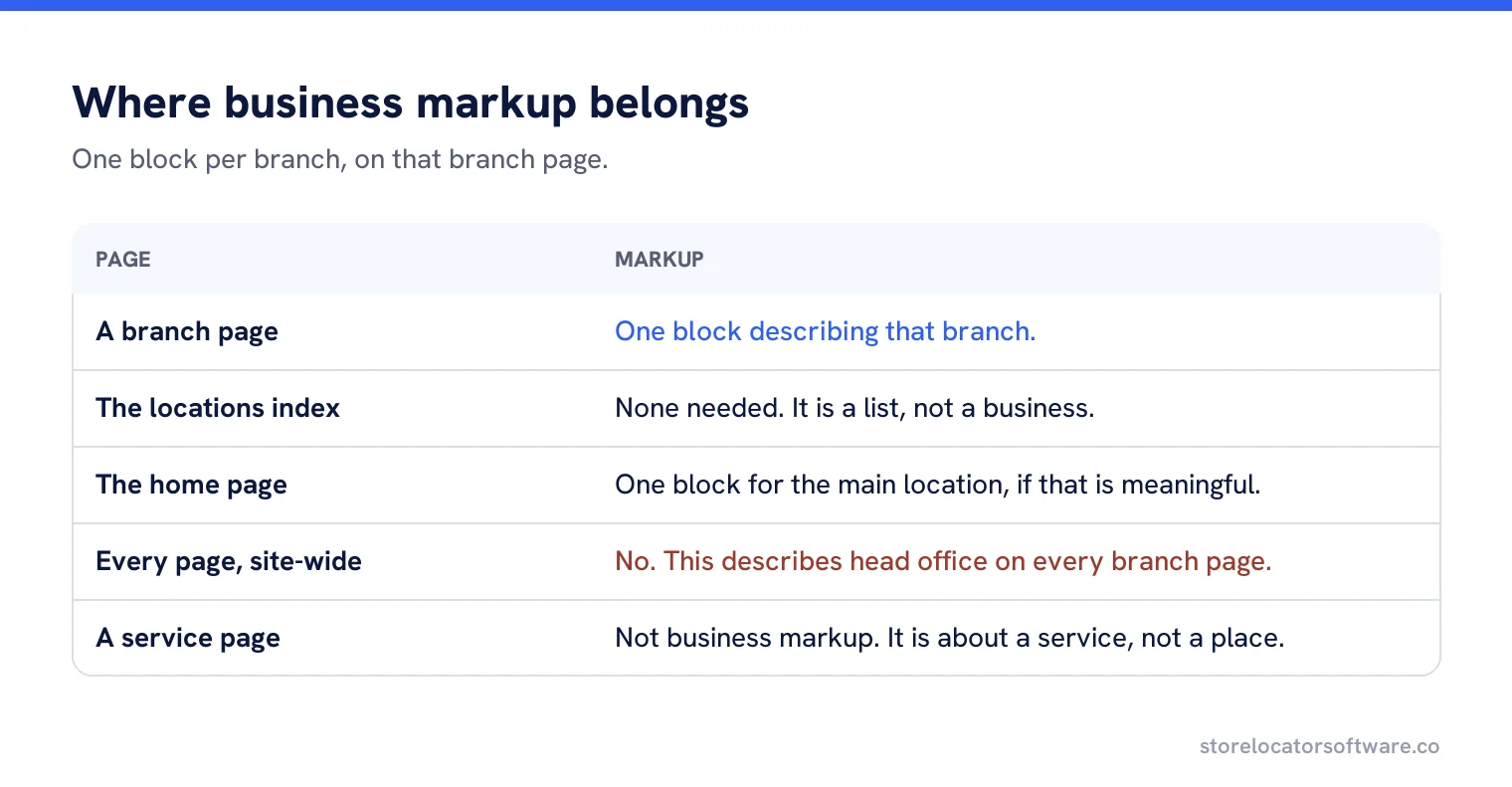
Where it goes
| Page | Markup |
|---|---|
| A branch page | One block describing that branch. |
| The locations index | None needed. It is a list, not a business. |
| The home page | One block for the main or head office location, if that is meaningful. |
| Every page, site-wide | No. This is the mistake that describes head office on every branch page. |
| A service page | Not business markup. It is about a service, not a place. |
What to include
- Name, exactly as on the profile and the sign.
- Full postal address, with the unit and the postcode format of that country.
- Telephone number, the published one.
- Opening hours, including anything that genuinely differs by day.
- The page URL for that branch.
- Geographic coordinates, where you have accurate ones.
Leave out anything the page does not show. Markup describing a feature nobody can see on the page is the fastest way to a mismatch nobody notices for a year.
One block, not one per department
A branch page describes one place. Resist the temptation to emit a block for the shop, another for the cafe inside it and a third for the car park. Unless those are genuine departments in the sense Google describes, the extra blocks add ambiguity rather than detail, which is the opposite of what the markup is for.
The duplicate block problem
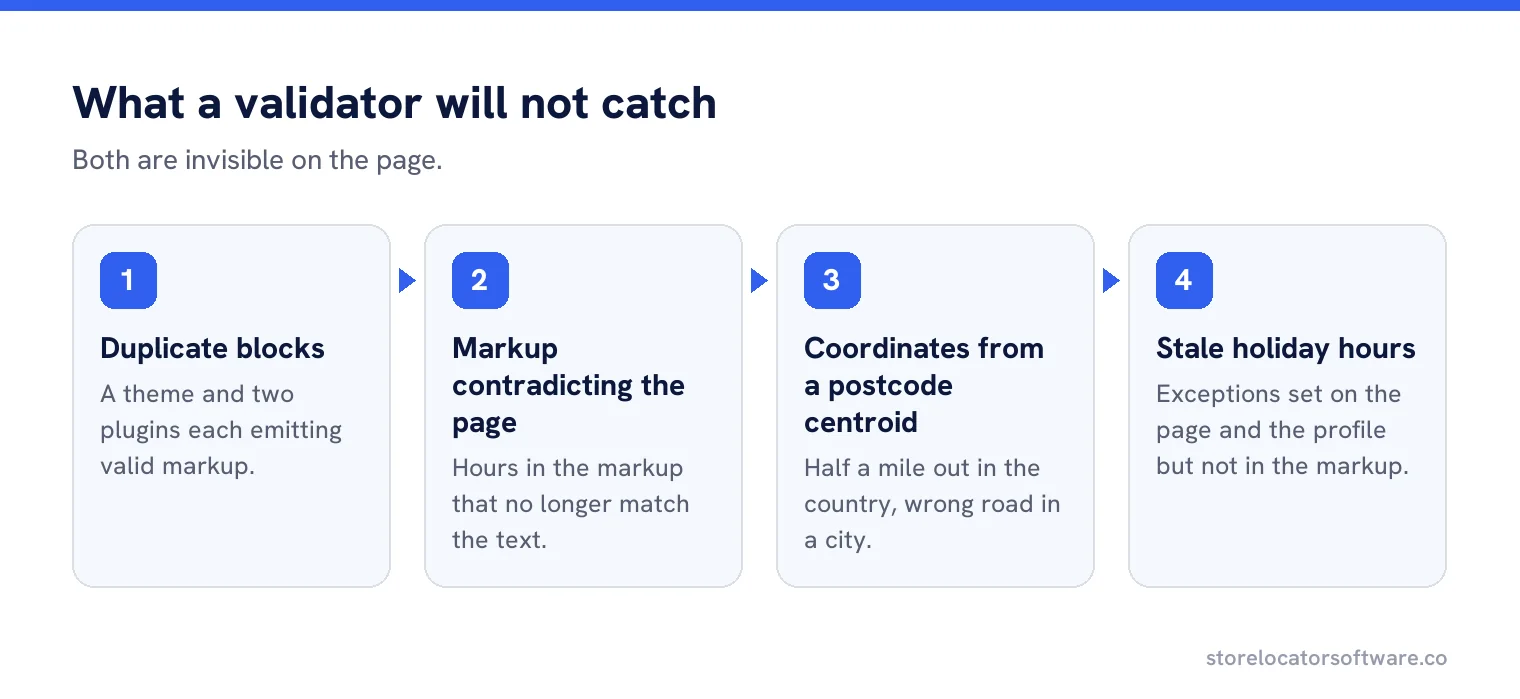
On content management systems a theme emits markup, an SEO plugin emits markup, and a reviews plugin emits a third. Each is individually valid, and together they describe a business with two names and three sets of hours.
Find it by viewing the page source and searching for the schema type. Fix it by turning off all but one source, which is almost always a setting rather than development work.
Generating it from your data
Hand-written markup goes stale the first time hours change. Generate it from the same location record that fills the page, so a correction updates both at once. That also removes the contradiction problem by construction: the page and the markup cannot disagree unless somebody makes them.
Coordinates, and getting them right
Latitude and longitude are worth including and worth checking. The usual error is a coordinate taken from a postcode centroid rather than the building, which in rural areas can be half a mile out and in cities can be on the wrong side of a dual carriageway.
Take them from the front door on a map, not from an address lookup, and spot check a handful against where the building actually is. It takes a minute per branch once and prevents the complaint that your own directions send people to the wrong place.
Validating a whole estate
Testing one page proves the template works. Testing the estate means checking a sample from each kind of location you have: a standalone branch, a concession, one with unusual hours, one in another country. Those four cover nearly every way a generated block goes wrong, and four checks is a job rather than a project.
Reviews in markup
Leave review markup alone unless you have a genuine, properly sourced review system and understand the rules. Marking up your own aggregate rating because it looks good in results is the most common reason a site loses rich result eligibility, and it is not necessary for any of the work described here.
Departments
Where a branch genuinely contains departments with their own hours, such as a dealership with a service centre, the markup supports describing them. The test is the same as for separate Business Profiles: real departments with their own staff and customers, not a section of a shop.
A worked check
A garden centre chain validated cleanly on every page and still had a problem. Two blocks appeared on each branch page: one from the theme describing the head office, with head office hours, and one from the location template describing the branch.
No tool flagged it, because each block was valid. The fix was a single theme setting, after which each branch page described one business, with the hours shown on the page, matching the Business Profile.
What it will not do
It will not make a thin page rank, it will not replace links to your location pages, and it will not get a branch indexed on its own. Markup helps a page that already works; it does not rescue one that does not exist as far as a crawler is concerned. Fix the URL, the link and the content first, then add the markup.
Hours in markup, and the holiday problem
Regular weekly hours are straightforward. Exceptions are where generated markup drifts from reality, because the Christmas hours get set on the Business Profile and in the page text while the markup keeps the ordinary week. If your system cannot express exceptions, it is better to keep the markup to the regular week and make sure the page text carries the holiday information prominently.
When to re-check
After any theme change, plugin update or redesign, which are the three events that silently add a second block or remove the one you had. Nothing changes on the visible page, so nobody notices until somebody looks.
Markup that matches the page
Generate structured data for every location from the same record that fills the page and your listings.
Frequently asked questions
Does my locator index page need structured data?
No. It is a list rather than a business. The markup belongs on each branch page, describing that branch.
What should the markup contain?
Name, full address, published phone number, opening hours, the branch page URL and accurate coordinates. Nothing the page does not show.
Why do I have two sets of markup?
A theme and one or more plugins each emitting a block. Each can be valid while together they describe a business with two names and three sets of hours.
Should I mark up reviews?
Leave it alone unless you have a genuine review system and understand the rules. Self-serving review markup is a common reason sites lose rich result eligibility.
How do I stop the markup going stale?
Generate it from the same location record that fills the page, so one correction updates both and they cannot disagree.
Sources
The Google documentation behind the guidance on this page. Google changes these pages without notice, so check the date on any figure before you rely on it.