
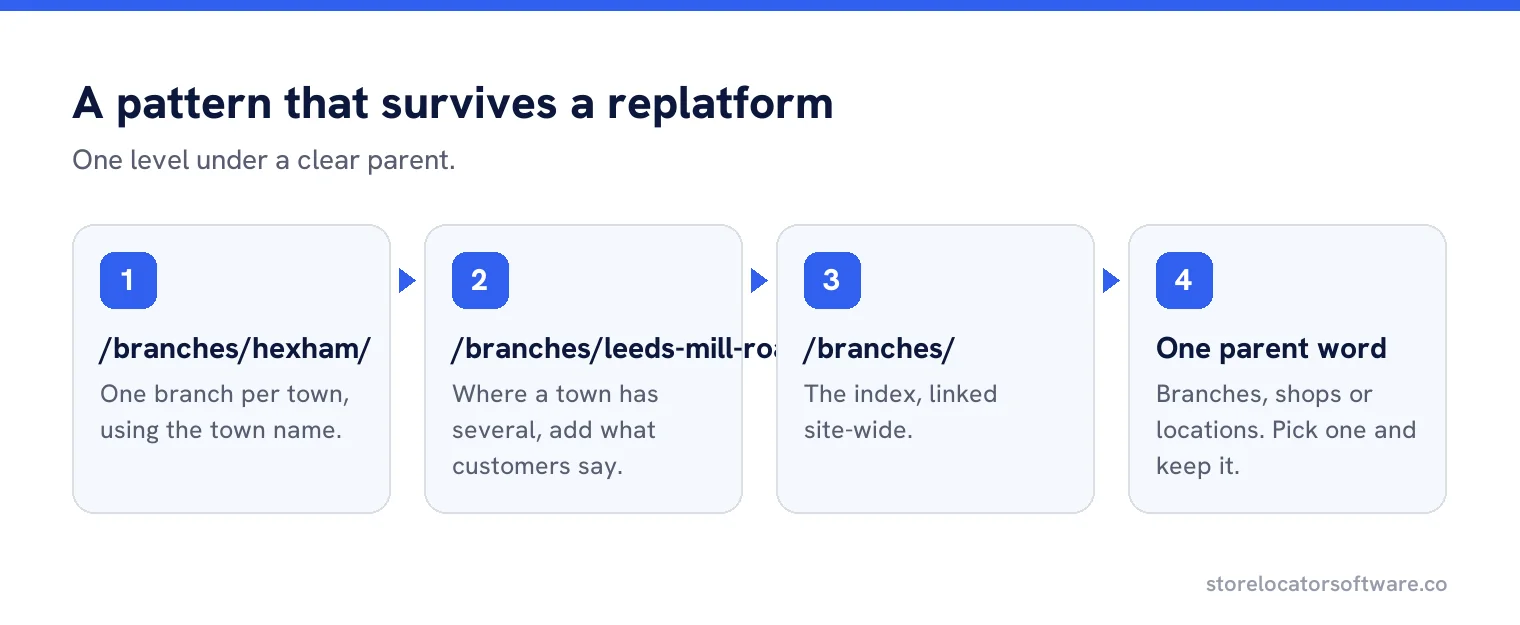
Pick one readable pattern and never change it. For most businesses that is a single level under a clear parent: /branches/hexham/ or /locations/leeds-mill-road/. Use the town, add a distinguishing word only where two branches share one, keep it lower case with hyphens, and avoid store numbers, parameters and dates. The cost of changing this later is a redirect map and a few months of recovery, so it is worth ten minutes of thought now.
URL structure for location pages looks trivial on day one on day one and is expensive to revisit on day four hundred.
A pattern that works
- /branches/hexham/ for one branch per town.
- /branches/leeds-mill-road/ where a town has several.
- /branches/ as the index, linked site-wide.
- Lower case, hyphens, no trailing parameters.
- The same word for the parent everywhere: branches, shops, locations. Pick one.
What to avoid
| Avoid | Why |
|---|---|
| /store?id=4821 | Not readable, not memorable, and parameters invite duplicate versions. |
| /branches/0147-hexham/ | Internal store numbers mean nothing to a customer. |
| /plumber-hexham-emergency-24hr/ | Keyword stuffing in a path, which fools nobody. |
| /north-east/northumberland/hexham/branch/ | Deep nesting that will need rebuilding when the regions change. |
| /branches/hexham-2024/ | Anything with a date in it is guaranteed to look wrong eventually. |
| Mixed patterns | Half the estate under one parent and half under another, usually after a merger. |
Why readable URLs still matter
Not because a word in a path carries weight, but because the URL is seen by people: in a search result, in a message, on a printed card, read out over the phone. A path somebody can say out loud and type from memory is worth more than any theoretical benefit, and it is free at the point of decision.
How deep to nest
One level under a parent is right for almost everybody. Region folders feel organised and create two problems: they rebuild themselves whenever the company reorganises, and they put the useful part of the URL further from the start. If you genuinely need regional index pages, make them pages that link to branches rather than folders that contain them.
Two branches in one town
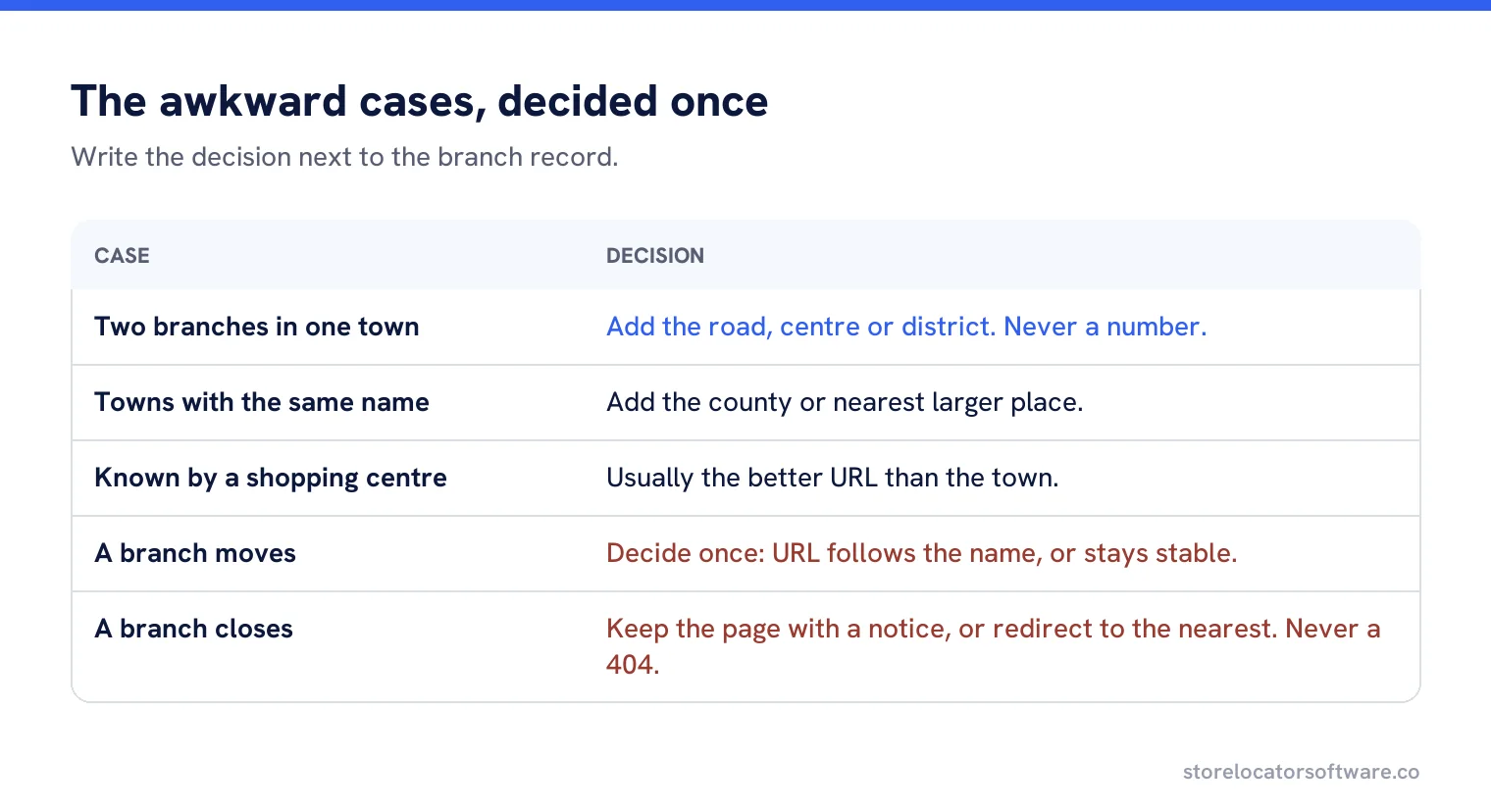
Add the distinguishing thing a customer would say: the road, the centre, the district. “Leeds Mill Road” and “Leeds Headingley” are what people call them. “Leeds 1” and “Leeds 2” are what the finance system calls them, and nobody searches for that.
Place names that are not simple
Every estate has a few. Towns with the same name in different counties. Branches named after a shopping centre rather than a town. Places with accents, apostrophes or two accepted spellings. Decide each one the way a customer would say it, then write the decision down next to the branch record so the next person does not re-decide it differently.
Where two towns share a name, add the county or the nearest larger place, not a number. Where a branch is known locally by the centre it sits in, that name is usually the better URL than the town, because it is what people type.
Slugs generated from names
Automatic slug generation is convenient and occasionally produces something unfortunate: a trading name with punctuation in it, a double hyphen, or a branch called “New Store” because that was its placeholder on opening day. Review the generated slug once per branch before it goes live, which is the only point at which changing it is free.
Countries and languages
Keep the country separation consistent with the rest of the site rather than inventing something for locations. If the site uses /uk/ and /ie/, locations sit under those. If it uses separate domains, the same applies. What causes trouble is a locations section that organises itself differently from everything else.
When a branch moves or renames
Decide once: either the URL follows the real-world name, in which case moving means a new URL and a redirect, or the URL is stable and the page content changes. Both are defensible. What is not is doing it differently each time, which produces an estate where nobody can predict a URL.
Where you do change one, redirect the old URL to the new page, not to the index, and update every internal link and every Business Profile that pointed at it.
A worked decision
A chain of 46 opticians had grown by acquisition and had four patterns in use: /store/123, /opticians/leeds, /our-branches/leeds-city/ and a handful on an old subdomain.
They standardised on /branches/town/ with a road suffix where needed, redirected everything else to its equivalent, updated the profiles and the footer, and kept a dated list of the old URLs.
Traffic dipped for about three weeks and then recovered above where it started, mostly because the four patterns had included two that were never linked from anywhere.
Trailing slashes, www and case
Pick one form of each, redirect the alternatives in a single hop, and use the chosen form everywhere including in your profiles and directory listings. This is dull, it takes an hour once, and it removes a category of duplicate-looking URLs that otherwise reappears at every audit.
Closed branches
When a branch closes for good, do not delete the page silently. Either keep it with a clear notice and a link to the nearest alternative, or redirect it to the nearest branch page. The worst option is a 404 on a URL that is printed on receipts, linked from directories and bookmarked by former customers.
Keeping the page for a few months, with one line explaining the closure and where to go instead, converts a dead end into a redirect that reads like a business rather than a technical rule.
Writing it down
Two lines in whatever document the website team works from: the pattern, and the rule for a second branch in the same town. That is enough to keep an estate consistent through three agencies and a replatform, which is the actual test this decision has to pass.
One pattern, generated for you
Create location pages at consistent URLs from your own location records, with redirects handled when a branch moves.
Frequently asked questions
What URL should a location page use?
One readable level under a clear parent, such as /branches/hexham/, using the town and adding a road or district only where two branches share a town.
Should I nest by region?
Usually not. Region folders rebuild themselves whenever the company reorganises. Use regional index pages that link to branches instead of folders that contain them.
How should I name two branches in one town?
With the thing a customer would say: the road, the centre or the district. Internal store numbers mean nothing to anybody searching.
What happens when a branch moves?
Decide once whether URLs follow the real-world name or stay stable. Either is fine; doing it differently each time is what makes an estate unpredictable.
Do trailing slashes and www matter?
Pick one form of each, redirect the alternatives in a single hop, and use the chosen form everywhere including profiles and directory listings.
Sources
The Google documentation behind the guidance on this page. Google changes these pages without notice, so check the date on any figure before you rely on it.